Key Takeaways
- SEO, GEO, and AEO aren't competing strategies. They target different outputs from different systems.
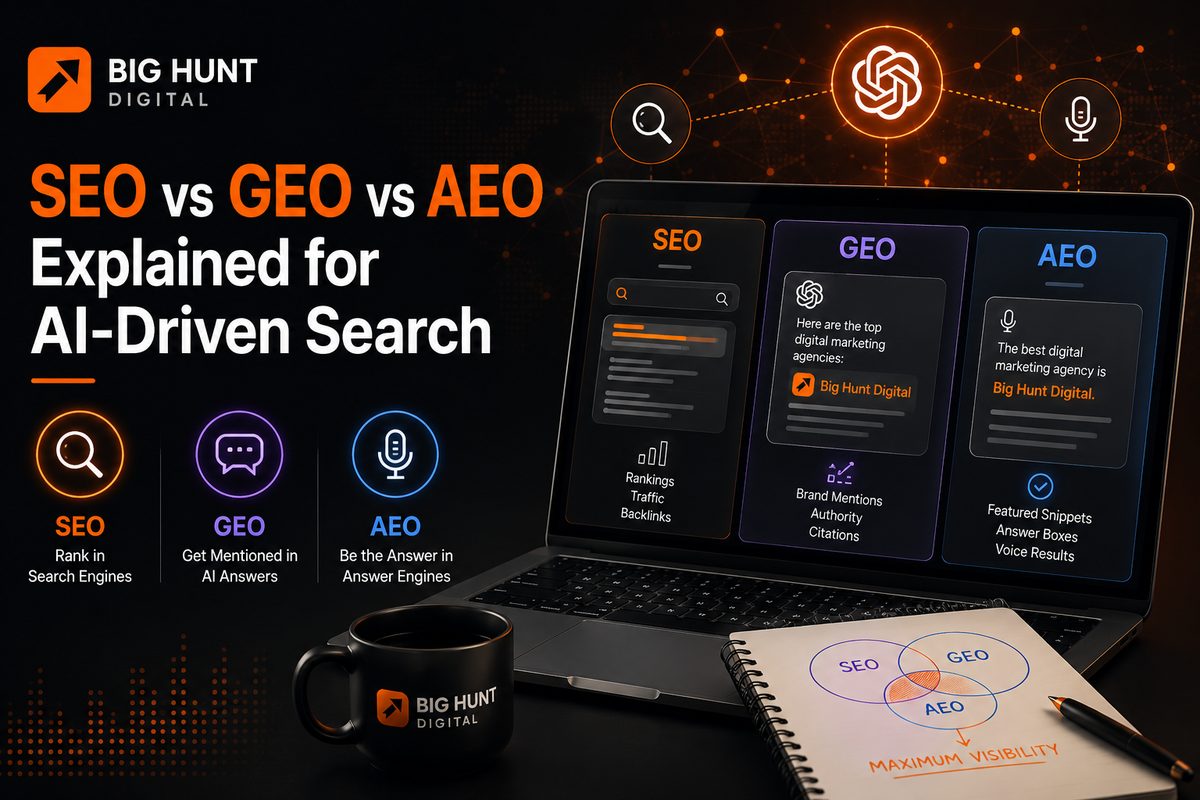
- SEO earns a ranked link. AEO earns the answer box. GEO earns a mention inside an AI-generated response.
- All three reward the same underlying work: clear structure, verifiable expertise, and content that answers a real question properly.
- Brand mentions on trusted third-party sites now influence AI visibility in a way they never did for classic rankings.
- You need one content plan built with all three outputs in mind, not three separate plans.
What SEO Means in Today's Search Landscape
SEO is the practice of making your website visible in search engine results. It still rests on technical health, on-page clarity, content quality, and link authority. What has changed is the weighting, because search engines now expect clear evidence that a credentialed practitioner stands behind the page.
The core pillars hold. Technical health covers site speed, mobile responsiveness, and crawlability. On-page work covers titles, headings, and how clearly a page signals its topic. Then content quality, then off-page authority from links on sites that carry real weight. Those fundamentals are the backbone of every SEO engagement we run.
What has shifted is E-E-A-T (Experience, Expertise, Authoritativeness, Trustworthiness). Google wants proof a real practitioner wrote the page. In practice that means named authors with verifiable credentials, first-hand detail only someone doing the work would include, and clear sourcing on any claim.
Here's what that looks like in a live audit. Two competing service pages, similar length, similar keywords. One says "our team has extensive experience delivering results." The other names the practitioner, states how long they've worked in the category, and describes a specific problem they solved and how. The second page holds up better, because the first one contains nothing a search engine can verify.
Commercially: SEO is where most high-intent traffic still lands. Someone comparing vendors or ready to buy usually ends up on a page they clicked. That's traffic you own outright.
What GEO Is and Why It Matters Now
GEO stands for Generative Engine Optimization. It targets AI tools that synthesise answers instead of listing links. Rather than competing for position one, you're competing to be one of the sources a model draws from and names, which depends heavily on structured data and outside corroboration.
Ask ChatGPT or Perplexity a question and there are no ten blue links. The system reads across sources, synthesises, and returns a conversational answer, sometimes citing and sometimes not.
What GEO actually optimises for:
- Structured data and schema markup, so machines parse your content without guessing.
- Brand mentions on high-authority third-party sites, since models weight external corroboration heavily.
- Content that answers a specific question thoroughly enough to be quoted rather than paraphrased.
- Consistent naming, positioning, and factual detail everywhere you appear.
That last point is where most businesses quietly lose ground. A common pattern: the service page describes the company one way, LinkedIn uses different positioning, an old directory listing carries a previous address, and a partner site names a service the company retired two years ago. Ask an AI assistant about that business and you get a confident, partly wrong answer assembled from all four. Reconciling those sources is unglamorous work with visible results.
If you serve specific regions, GEO connects directly to local optimisation. Location-based queries in AI search are growing quickly, and weak local signals mean you simply don't surface for regional questions.
Understanding AEO and Answer-Based Search
AEO, or Answer Engine Optimization, targets users who want a direct answer without clicking. That includes voice queries, featured snippets, and answer modules above organic results. The main lever is formatting, which means matching headings to real questions and answering concisely underneath.
FAQ sections, numbered steps, tight definitions, and short paragraph answers all perform well. If someone asks "what is GEO in digital marketing" and your page carries a clear answer of roughly 40 to 60 words directly beneath a matching heading, you have a real shot at the snippet.
A practical rule from doing this repeatedly: write the heading in the words a customer would use, not the words your industry uses internally. Pages that lose snippets often lose them because the heading says "Our Generative Engine Optimization Methodology" when the query was "what is GEO."
AEO and GEO share a lot of DNA. Both reward clear answers, structured content, and machine readability. The difference is destination. AEO targets features inside a results page, GEO targets the response an assistant generates.
Commercially: AEO often wins visibility without a click, which frustrates anyone tracking sessions alone. Treat it as positioning. Being the source of the answer builds recognition that shows up later as branded search.
Key Differences Between SEO, GEO, and AEO
All three increase search visibility, but in different environments with different outputs. SEO produces ranked links and rewards depth and authority. AEO produces a single highlighted answer and rewards structure. GEO produces a synthesised response and rewards reputation and clarity.
| SEO | AEO | GEO | |
|---|---|---|---|
| Surface | Google, Bing organic results | Featured snippets, knowledge panels, voice assistants | ChatGPT, Perplexity, Google AI Overviews |
| Output | A ranked list of links | A single highlighted answer | A synthesised conversational response |
| Primary lever | Technical health, depth, link authority | Formatting and concise phrasing | Brand authority, structured data, external mentions |
| Success looks like | Position and click-through | Owning the answer box | Being cited or named in the response |
| Best for | Capturing high-intent traffic | Quick-answer and voice queries | Research and comparison-stage queries |
The useful thing about seeing them side by side is noticing how little conflict there is. Almost nothing you do for one actively harms another.
How These Strategies Work Together
You don't choose between them. They stack in a specific order: SEO provides the crawlable, authoritative foundation, GEO builds brand authority and machine readability on top, and AEO structures key sections for direct extraction. One well-built page can satisfy all three at once.
Without a technically sound site, credible content, and real link authority, the other two have nothing to work with. AI systems still discover and evaluate you through crawlable pages, which is why the state of your web design and development sets the ceiling on everything above it.
Build brand authority and machine readability: natural language, structured data, and consistent mentions on platforms your audience trusts.
Headings phrased the way people ask questions, a concise answer immediately underneath, FAQ schema where it genuinely fits.
The efficiency is the whole point. Content that is well structured, authoritative, and clearly written satisfies all three simultaneously. One plan, three outputs.
Best Approach for Ranking in AI Search Results
Audit what you have, fix technical issues first, then rewrite your highest-value commercial pages for clarity and answer structure, then build external mentions. Prioritise depth over volume, and test manually how AI tools currently describe your brand and your category.
Start with an honest audit. Is the site technically clean? Does the content answer real questions directly, or circle them? Is your brand mentioned anywhere credible outside your own domain? Is your structured data present and accurate?
Then prioritise quality. One thoroughly researched page outperforms ten thin ones on every surface. AI systems particularly favour content contributing something original: proprietary data, a practitioner's perspective, or a genuinely different angle. Restating consensus gives a model no reason to cite you over anyone else.
Sequence matters more than people expect. Fix technical issues, then rewrite the commercial pages, then pursue mentions. Reversing that order rarely works, because authority pointed at a weak site doesn't convert into visibility.
For tracking, Search Console and your ads dashboards cover classic search. For AI visibility, test manually. Query your category the way a buyer would, note whether you're named or a competitor is, check whether the details are accurate, and repeat on a schedule so you can see movement. Emerging AI monitoring tools are worth watching as they mature.
If you want the platform-specific mechanics, we've broken down how to get featured in ChatGPT search results and how to rank and get cited on Perplexity AI separately, since the two reward slightly different emphases.
None of this finishes. Search surfaces keep shifting and your visibility follows. If you want a baseline before you start, request a free audit and we'll map exactly where your brand stands today.
The Takeaway
This isn't three problems. It's one problem with three answers: be technically sound, be genuinely authoritative, and be easy for both people and machines to quote accurately.
The businesses that struggle here treat GEO and AEO as bolt-on tactics layered over neglected fundamentals. The ones that win build a single content and authority strategy, then structure it so every surface can use it. That work compounds, and it holds up each time a new AI tool gains traction.
The gap between those two groups is widening right now, while AI search habits are still forming. Getting your foundation right today costs far less than catching up later.