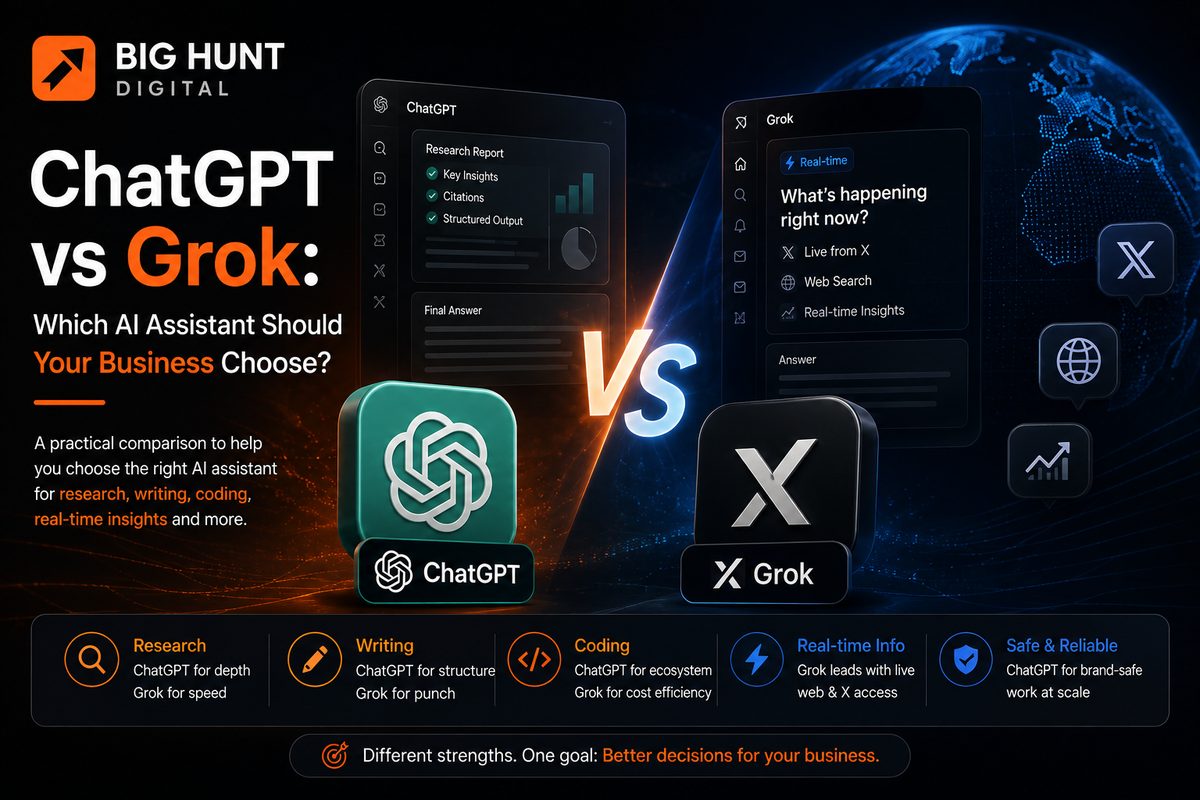
Key Takeaways
- ChatGPT is the safer default for research depth, ecosystem maturity, and anything a client sees.
- Grok's structural edge is live web and X access, which makes it the better option for breaking news and real-time sentiment.
- Benchmark scores and API rates change with nearly every release. Architecture and integration depth move slowly, so decide on those.
- For most teams past a handful of people, running both is cheaper than forcing one tool into work it wasn't built for.
- Which assistant your team uses and which assistants your customers use are separate questions. The second one has more revenue attached.
Why the ChatGPT vs Grok Comparison Is Harder Than It Looks
Most head-to-head AI articles age badly because they're built on numbers: benchmark scores, context window sizes, tokens per second, version names. All of that shifts within months. An article anchored to those numbers is wrong shortly after publishing, and it points you toward a decision based on the detail least likely to still be true when you act on it.
What holds up is structural: how each product is architected, what each company optimises for, where the integration surface is deepest. Those move slowly, since they reflect years of engineering and business decisions rather than one release. That's the focus here. For current benchmarks or exact API rates, go to OpenAI's and xAI's own documentation.
ChatGPT vs Grok: What Each Tool Actually Is
ChatGPT is OpenAI's assistant, launched in 2022 and now one of the most widely adopted software products in any category. It handles text, images, and voice, supports file analysis, and sits on a mature developer platform. Its defining trait is breadth: more third-party tooling, documentation, and enterprise deployment experience than any competing assistant.
Grok is xAI's assistant, built with native access to X and live web data. It handles text and images, has a research mode, and offers a developer API. Its defining trait is immediacy, designed around knowing what's happening now, and it answers with less hedging than most competitors.
Both offer free tiers, paid individual and team plans, and pay-per-token APIs. The structure is similar; the philosophy isn't. As more buyers use AI assistants to discover businesses, optimising only for traditional search leaves gaps. How ChatGPT, Grok, and others discover and recommend your brand is now part of the same visibility problem, which is exactly what our AI SEO services are built to address.
ChatGPT vs Grok: Feature Comparison
Written qualitatively on purpose. No scores, because scores don't survive contact with the next release cycle.
| Dimension | ChatGPT | Grok |
|---|---|---|
| Research | Deeper and structured. Often asks clarifying questions, returns organised output with citations. Suited to reports you have to defend. | Faster and lighter. Strong at surfacing live discourse. Less structured citation, less suited to formal documents. |
| Writing | Consistent tone control, reliable long-form structure, handles brand voice well. More cautious by default. | More direct out of the box. Good for punchy short-form and social copy. Needs firmer prompting for formal registers. |
| Coding | Longer production track record, deepest third-party tooling (IDE integrations, agent frameworks, CI/CD). Mature function calling. | Genuine recent investment in coding and agentic tasks. Competitive flagship API economics at volume. Smaller toolchain. |
| Real-time info | Web search layered on a base model, not central to the architecture. | Structural advantage. Live web and X access is foundational. Best option for breaking news and live sentiment. |
| Images | Tighter moderation, conservative defaults. Predictable for client and brand work. | More permissive policy. Fewer refusals, more oversight required. |
| Subscriptions | Entry-level individual plan has historically been the lower of the two. | Entry individual plan has historically sat above ChatGPT's. |
| API | Wider range of tiers, more mature agent and function-calling tooling. Generally the higher price point. | Flagship pricing has generally undercut ChatGPT's. Fewer tiers, leaner tooling. |
| Best for | Depth, consistency, integration breadth. | Freshness, speed, API cost efficiency. |
Subscription tiers have stayed comparatively stable across multiple model generations, which is why it's reasonable to describe their relative positions here. API rates shift with nearly every release from both companies, so build a budget from official documentation the week you decide rather than from a number in an article, this one included.
ChatGPT vs Grok: The Splits That Actually Matter
ChatGPT's research is built for something you can hand to a client or regulator: organised, sourced, defensible, and slower. Grok is built to answer fast: shorter, quicker, better at what's being said right now than what's been published over time. A due-diligence memo and a same-day reaction check aren't the same task, and expecting one tool to be optimal for both is where most disappointment comes from.
ChatGPT's ecosystem lead is real, a function of a multi-year head start; the odds someone has already built and debugged the integration you need are higher. Grok's counter-advantage is narrower but genuine: native depth on X. For a brand whose monitoring or content strategy centres on that platform, it's the whole reason to have Grok in the stack, and it pairs naturally with the work our social media marketing team already does there.
ChatGPT's conservative defaults help in client-facing and regulated work and add friction in creative work. Grok's permissive posture is the inverse. What matters is whether your output has a compliance reviewer at the end of it.
Both offer business and team tiers that keep conversation data out of training by default; free and individual tiers vary. Read the current terms for your specific plan before running client, confidential, or regulated work through either, and treat a free tier as unsuitable for that work regardless of what current terms permit, since these policies get revised.
ChatGPT vs Grok for Business: How to Choose by Team Type
SEO agencies: Default to ChatGPT for briefs, audits, and client deliverables, its structured research wins here. But visibility across both matters more than internal preference, since clients' customers are asking both about them. That's the actual discipline behind AI SEO, and it's covered in more depth in our breakdown of SEO vs GEO vs AEO. Keep Grok for trend detection and reactive content.
General operations: Standardise on ChatGPT unless you have a specific reason not to, its integration and admin maturity reduces friction across finance, support, and HR. Add Grok as a targeted second tool where live information changes the outcome, and buy business tier for anything touching company or customer data.
Developers: Skip the leaderboard and run both against your own repo and test suite for a week. Grok's API economics matter more at high token volume; ChatGPT's tooling maturity matters more for complex, tool-heavy orchestration.
Content creators: Use ChatGPT for structure, outlines, long-form drafting, and tone consistency. Use Grok for the top of the funnel, what's being talked about and what angle is unclaimed. Grok for discovery, ChatGPT for construction.
Marketing teams: Brand and lifecycle content sit better with ChatGPT's consistency; social listening and reactive publishing sit better with Grok's live access. If only one subscription is realistic, start with ChatGPT and revisit once real-time work becomes a recurring bottleneck.
Common Mistakes When Comparing ChatGPT vs Grok
- Treating a benchmark as a purchase decision. Scores measure standardised tasks; your work isn't standardised.
- Comparing mismatched tiers. Free vs paid, or individual vs business, is a meaningless comparison. Match the tier first.
- Testing with generic prompts. Feed both tools real tasks from your backlog, not "write me a poem."
- Assuming last quarter's answer still holds. Both companies ship frequently, so re-check periodically instead of treating old conclusions as permanent.
- Ignoring switching cost. Migration cost across prompts, integrations, and habits is real. A modest edge rarely justifies rebuilding a working workflow.
- Framing it as either-or. Running both is often cheaper than forcing one tool into work it isn't built for.
- Confusing tool choice with market visibility. Which assistant your team uses and which ones your customers use are different questions, and the second has more revenue attached.
When Running Both Makes Sense
For most teams past a handful of people, it does. ChatGPT as the standing default for research, writing, coding, and anything a client sees, with Grok brought in deliberately for live-information tasks.
There's a second reason to watch both that has nothing to do with internal workflow: your prospects are already asking both assistants about your industry and your competitors. If you want to influence how you're described, start with the mechanics of getting featured in ChatGPT search results, then work through the same exercise on Perplexity. Weighing ChatGPT vs Grok purely as an internal tooling question is only half the picture.
Final Verdict: ChatGPT vs Grok
There's no universal winner, and any article that hands you one is flattening a decision that depends on your context.
ChatGPT is the safer default for most business workflows, research, writing, coding, and anything a client sees, because of ecosystem depth and a longer track record. Grok earns its place where live information or API cost efficiency outweighs polish and integration breadth.
The teams getting the most out of either aren't the ones that picked a camp. They matched the tool to the task, kept the decision under periodic review, and remembered that how these assistants describe their business to customers matters at least as much as which one they work in day to day. That framing will still be true after the next release from both companies. Most of the numbers you'd have compared instead won't be.
If you want to know how ChatGPT and Grok currently describe your brand, request a free audit and we'll map where you stand today.